Overview
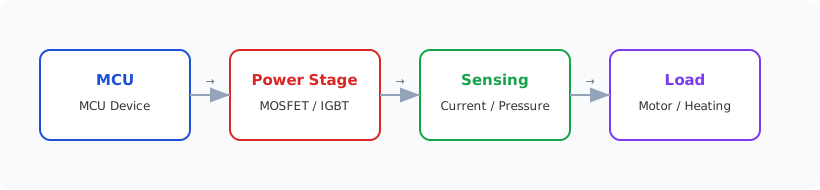
Air conditioners, washing machines, refrigerators and small pumps are among the highest-volume motor-drive products in the world, and they share a common demand: a compact, low-cost, reliable inverter that can run from a single-phase or three-phase mains supply. Silan IPM intelligent power modules were developed for exactly this class of equipment, and they are widely used in appliance manufacturing. Because an IPM integrates the three-phase inverter bridge, the gate drive and the protection, the appliance designer can drive the power stage directly from a microcontroller and concentrate on the control algorithm and the user experience.
Why the Appliance Market Chooses IPM
A discrete inverter needs isolated gate drivers, dead-time generation, overcurrent sensing and protection logic, all designed and qualified by the appliance maker. An IPM brings that circuitry inside the module, factory-tuned and tested, so the board becomes smaller and the design cycle shorter. The module also outputs a fault signal when a fault occurs, which lets the controller shut down the motor safely. In a product built in millions of units, that reduction in parts count, board area and engineering effort is decisive. Silan offers a broad 600 V three-phase IPM family from about 10 A to 30 A, so a designer can match the current to the motor without changing the interface.
Matching the Module to the Appliance
For a 220 V AC supply, the rectified DC bus sits near 320 V, so a 600 V IPM gives comfortable margin. A typical compressor or drum drive might use a SDM15G60TD8 rated at 15 A, while a larger compressor or a small servo drive could use the SDM30G60FD8 rated at 30 A in the same DIP-24 family. Choosing the current rating follows the motor rating plus overload, and the thermal design confirms the choice. Because the family shares an interface, scaling from one rating to another does not force a control-side redesign.
Control Interface
A Silan IPM is driven directly by a microcontroller at a 3.3 V or 5 V logic level and needs a single 15 V control supply. The designer selects a current-sense resistor that sets the overcurrent trip level, and respects the protection thresholds for overcurrent, thermal shutdown and bootstrap supply monitoring. This simple interface is one reason IPMs reduce the control-board complexity so much compared with a discrete power stage.
Efficiency and Comfort
Modern appliances are judged on energy labels and on comfort. Higher switching frequency reduces motor noise and torque ripple, which matters for a compressor that runs all night, but it raises switching loss. Silan's low-loss IGBTs inside the IPM keep loss low enough to allow higher frequency within the same thermal budget, so the appliance can be quieter and more efficient at the same time. The integrated protection also lets the drive ride through the transient conditions of a mains disturbance safely.
Thermal and Mechanical Design
Appliance enclosures are small and often poorly ventilated, so thermal design is critical. The IPM must mount flat against a heatsink or a metal chassis with a thin, uniform interface, and the case temperature should be verified at full load. Because the module protects itself with a thermal-shutdown threshold, a marginal thermal path does not necessarily destroy the part, but it does limit the output and hurt reliability. Good thermal design keeps the protection in reserve rather than active during normal operation.
Reliability and Documentation
Appliance makers require consistent parts and complete documentation. BeiLuo supplies factory-traceable Silan IPM with import declaration, certificate of origin and RoHS files on every order, so supplier audits pass smoothly. Mainstream IPM ratings are held in regional stock, which keeps production lines supplied from prototype through volume. Our FAE team supports the control interface and the thermal path, so a new appliance drive reaches production without late surprises.
Conclusion
The appliance and HVAC market rewards integration, efficiency and reliability. Silan IPM delivers all three by putting the inverter, the driver and the protection in one package, and BeiLuo makes those modules genuinely available with documentation and engineering support.